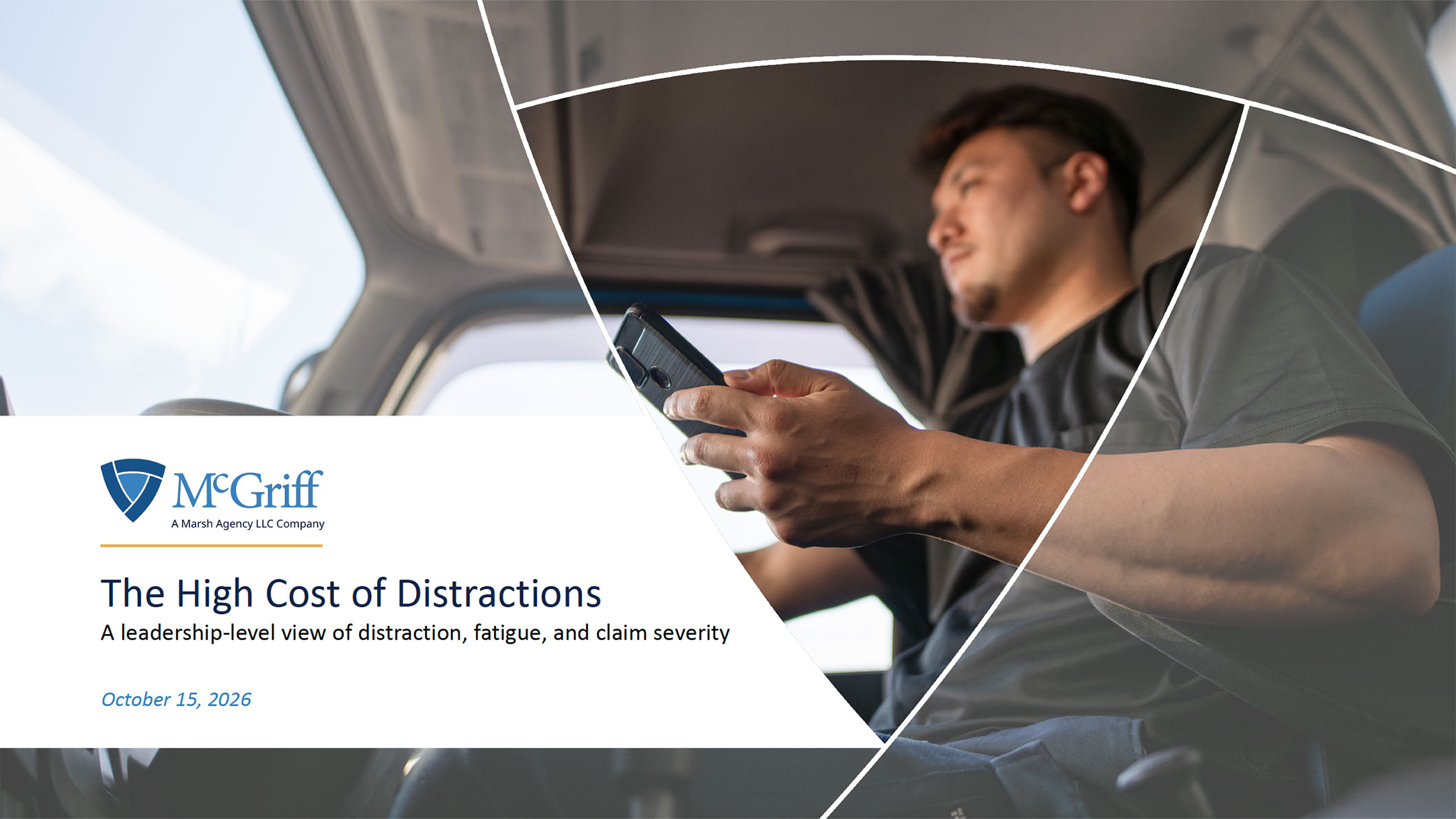
Hello everyone.
Distracted driving is escalating the severity of losses across the trucking industry, causing costly disruptions and exposing fleets to costly settlements.
In verdicts today, we will discuss emerging risk patterns observed in the latest claims data and provide strategies to strengthen driver awareness, close operational gaps and defend your fleet effectively.
On behalf of McGriff, I would like to take this opportunity to thank each of you for joining us today as we discussed the high cost of distraction, protecting your fleet drivers and balance sheet.
My name is Lesonya Wilder and I will be your host for the call today.
There are just a couple of housekeeping points that I would like to share with you before we get started.
This is a live session and you are in listen mode only.
If you have any questions at any time during the presentation, feel free to utilize the chat box or Q&A box to type in your questions and we will address them during the Q&A segment.
If time doesn’t permit us to answer the questions after the presentation, we will be sure to capture them and provide the responses afterwards.
Now it brings me great pleasure to introduce to you our speakers for the hour.
We have Bill Robertson, a Transportation Risk Management Specialist with McGriff.
Bill has a passion for improving his clients overall operations and focus on helping clients identify, access, and manage loss exposures to reduce their total cost of risk.
He’s held various safety and lost control positions since 2003.
Bill’s career spans almost 3 decades in the trucking industry including various positions with large LTL and TL carriers.
Bill spent 10 years as Corporate Director of Safety and Human Resources for a large Mississippi based truckload carrier.
His experience in several faucets of the trucking industry allows him to help clients develop their fleet safety programs and make better decisions in driver hiring and retention.
Bill is an active member of the Safety Council of State Trucking Associations in Mississippi, Alabama and Tennessee.
He is also a member of the Safety Management Council of the American Trucking Association.
Bill attended the University of Southern Mississippi and he holds the Certified Insurance Counselor designation and a Mississippi Agent’s license for property and casualty insurance.
We also have Mike Halsey, who brings over 25 years of experience in the transportation industry.
He began his career with the Kansas Highway Patrol as an MCSAP Trooper and forensic collision reconstructionist.
His professional journey spans roles in compliance and transmutation with one of the largest fleet carriers in the United States, as well as strategic positions within the energy sector supporting midstream and downstream operations.
Before joining McGriff, Mike served as a Risk Control Representative at a leading commercial trucking insurance carrier, where he spent six years advising clients on safety practices and risk mitigation strategies.
He was recognized as a specialist in transportation and risk during his tenure, underscoring his deep expertise and commitment to injury industry excellence.
Mike attended Fort Hays State University in Hays, KS and hosts a certified director of safety designation from the North American Transportation Management Institute.
He has been an active member of the Houston Chapter of the Texas Trucking Association since 2014, contributing to local initiatives and professional development within the trucking community.
And then finally we have Matt Frazier, a third generation transportation professional who brings over 25 years of experience in the transportation industry.
He began his career with a consulting firm based in Birmingham, AL conducting Department of Transportation mark audits and client specific compliance initiatives and training.
After that, he moved into the industry as a safety professional for both private and for hire transportation companies in the Southeast, developing and implementing their safety programs.
Matt recently served as Vice President of Safety and Compliance for leading transportation company in the flatbed industry.
He was a founding member of the company developing and implementing safety and maintenance programs.
Matt was recognized as the 2019 Alabama Trucking Association Safety Professional of the Year due to his safety initiatives, analytical program development, and commitment to industry excellence.
Matt attended Athens State University in Athens, AL and holds the certified director of safety designation from the North American Transportation Management Institute.
He has been an active member of the Alabama Trucking Association for over 25 years and currently serves on its Safety and Maintenance Management Council, Steering Committee, and Truck Driver Championship Committee.
So without further ado, I would turn it over to Bill to kick off the presentation.
Thank you, Lesonya.
I would also like to welcome all of you to this webinar.
The core message we have is, is that distraction is not just a safety issue, is a business and a liability issue.
This webinar is designed for executive leadership and safety management so the discussion will stay focused on loss severity, operational controls, and the practical steps fleets can actually execute.
The trucking industry is seeing more severe outcomes when distraction is evolved.
A single event can create vehicle damage, cargo loss, service disruptions, claims expense, legal cost, and reputational damage.
Let’s look at the structure of the section of this session.
First, what the claims data and emerging patterns for showing.
Secondly, we’ll go and why traditional programs are just not enough.
And 3rd, how fatigue management fits into the picture.
And finally, what executives should do next, our objectives for this, excuse me for this webinar is not general distracted driving Refresher is intended to help leadership understand why distraction is creating more severe losses and what a stronger safety program needs to include.
First objective is a business impact, why severity is rising.
The second is a gap in traditional programs.
Third is the operational lens, what usually fails in a serious claim.
The 4th is the action orientation, what leaders can direct, measure and reinforce.
And I’ll close by reinforcing that the value of the session is not just awareness, it is helping leadership to make better decisions about controls, investments and accountability.
And now I’ll turn it over to Mike Halsey.
Thank you, Sir.
I’m going to cover some of the the patterns that are emerging in the claims data.
And some of the worst losses often involve multiple exposures all at once when distractions, fatigue and time pressures all tend to overlap.
So the first pattern we’ll look at is phone use and in cab multitasking.
What does that look like?
So we’re talking about messaging, using cell phones, handheld devices.
We’re, we’re changing routes in route to destinations after leaving terminals, we’re leaving customers and vendors, warehouses, eating, eating in the cab.
We’ve got all kinds of videos showing drivers, both hands off the steering wheel, chowing down on the hamburger or something of that nature, paperwork, doing paperwork while they’re driving down the road.
They’ve got their knees on the wheel and a clipboard on one hand and pen in the other hand.
And then that’s just from from the videos that that we’ve been able to see, the messaging piece is a pretty significant piece.
I had a conversation with one of our transportation attorneys at one point and I asked him, I said, if there’s one thing I could bring back to my carriers that would be significant and would would help them in the court cases that you’re seeing, what, what message would you have me relay to them?
And that message said, without a doubt, hands down, get the cell phones out of the trucks.
They’re killing me in court.
And at this time, this was about five years ago.
And I said, man, that’s crazy.
We’ve got regulations.
We’ve got state laws, we’ve got local laws.
We got municipal laws, We’ve got policies.
He said, yeah, we sure do.
And they’re nobody’s following them.
And I said, OK, well, I’ll take that advice and I’ll see what see what’s going on when I speak to my carriers.
And sure enough, I started asking the carrier carriers, yeah, we’re policies, yes, they’d have policies.
They knew their policies.
And they knew that there was federal law.
They knew was state law, knew there was local law.
And then when I’d ask him, well, how are you dispatching?
And they’d say, oh, we’re sending drivers text messages.
I’d say, OK, so you directly understand that that is a violation of your own policy and federal law.
And the answer I got was, well, we don’t know what else to do.
That’s what we’ve been doing forever.
That’s just how we’re doing it.
So opening up that dialogue, that conversation of just because we’ve been doing it doesn’t mean that’s the way we need to continue doing it.
And that is one of the most common things that I see throughout the carriers that I speak with who are utilizing a means of dispatch that is distracting in nature.
So why does that matter?
Because your attention is divided using multi multiple different distraction techniques when there’s a high risk action in play.
So multitasking is a myth and I like to give demonstrations about how it it’s nearly impossible to do the same task as fast when you’re multitasking.
And that example uses counting 1 to 26 and then saying the alphabet and you do that together.
So if you do it individually you could do it pretty quickly.
But when you try to say A1B2C3 around J, people kind of tend to have the wheels fall off of the bus and it takes significantly longer to do the same 2 tasks then when you would have just stuck with each one individually.
So our brains are wired.
Some people can do many tasks quickly, but it gives this perception of multitasking.
So that is definitely a myth.
We I know it’s something we all some of us pride ourselves in.
Oh, I’m a great multitasker.
Well probably are good at doing tasks individually very well.
So the second look at would be fatigue and extended duty cycles.
Fatigue awareness is a is a growing trend.
What we’re seeing a lot of these nuclear verdicts that are coming out, not only with drivers that may not be qualified to be in the trucks, but a piece of that is the distracted driving and also fatigued driving.
And what does that look like?
You know, we’ve got drivers that are on the road all hours of the day, 24/7.
That’s what keeps our country running is keeping trucks on the road, products gone and getting to customers, getting from warehouses, source materials, getting to their destinations to make those products.
And so that that is the nature of transportation.
And so we’ve got missed breaks.
Guys are, are are forced or they’re trying to make these tight schedules.
They’re already working really long shifts, you know, 11 hours, 11 and 14’s hours of service.
And I know that when when I try to drive 11 hours straight, that’s a very tough thing to do.
And including putting that into they’re doing, some guys are doing manual laborers.
We’ve got drivers that are lumping their own loads.
We’ve got drivers that are doing some very hard physical labor in between their their driving opportunities.
So those do play a large factor in that as well.
And so why does that matter?
So fatigue and, and being on duty for an extended period of time is it creates slow reaction times and reduce judgement.
There’s a comparison, there’s a study that was done that compared drunks with fatigued drivers.
And as a former law enforcement officer, doing Duis and, and stopping drivers that are impaired was one of my duties that I, I had.
And a lot of the same standardized field sobriety testing indicators that we would look for are also the same indicators.
And someone that is fatigued.
So we’re talking slurred speech, bloodshot eyes, disorientation, slower reaction times.
But the very first thing to go in someone that who’s impaired or under the influence of alcohol is their first thing is judgement.
That’s the first thing to go.
And it’s also one of the first things to go when you’re fatigued as well.
So we start making poor decisions, we’re missing exits.
We’re, we’re taking risks that we would not normally take and we’re, we’re taking loads that we maybe not should have taken.
We knew we were too tired or should have taken that extra 1, but making poor decisions.
So that’s why it’s significant.
There’s a phenomenal course fatigue management through the the National Fatigue Management Awareness Program and there are links to that through McGriff, McGriff resources.
If you guys have access to that or get a hold of one of us, we can get you to that location.
It is a phenomenal resource that’s been made available related to fatigue management training and and policies.
Number three, I’ve got for dispatch and scheduling pressures.
Of course with the the ever rising cost of to do everything from shopping to driving to running every business, the things are things are going up, cost of everything is going up, but that doesn’t necessarily mean we’re getting paid more to do it or you’re receiving more to do it.
So therefore the the tendency is to try and cram more into that same day to get more dollars out of that same time schedule, that same 11 hour 11 and 14.
So dispatch is put under very tight, tight schedules there.
They’ve got goals to meet and they’ve got Etas, tight Etas, repeated check insurance and this, this JIT culture just in time culture.
There was actually a carrier that I worked with called JIT just in time.
I was like, man, should you say, hey, we got plenty of time, but that’s, that’s the culture is we get it there just in time.
And so drivers are pushed toward making unsafe trade-offs.
They’re they’re, they’re operating fatigued, they’re operating distracted and they’re, they’re operating with, with judgement that is is impaired.
So number 4A low visibility on behavior trends.
So we’re seeing events that are treated as like a one off event and and there’s no pattern recognition.
There’s a surprising amount of carriers that are still not utilizing telematics or in cab cameras, any data that will monitor driver behavior.
It’s becoming more frequent and a lot more insurance carriers are requiring that as a part of extending coverage or extending quotes for coverage.
And so we are seeing an increase in carriers adopting those in the trucks.
And with those adoptions, we’re also seeing a decrease in the number of collisions that are related to risky behaviors.
So rear ending rear end collisions have actually gone down and and traded places with lane change collisions.
Lane change collisions are have now been one of the most frequent collisions we’re seeing.
But for the longest time, the rear end collision was the most frequent or common collision that we were seeing.
1 distractions and also two following too close.
Drivers were just absolutely trying to get it there just in time and pushing the envelope.
And so if you are able to track those trends and see those patterns, then you’re able to do ongoing coaching, you’re able to have leadership engaged to see those events as they’re happening in real time and address the issues and address the behavior before we have a frequency event lead to a severity event.
So the fleet has to be able to fix those reoccurring exposures.
And those patterns need to, to not go unchecked.
They need to have, there needs to be coaching, there needs to be accountability, needs to be more than just a hey, Bill, I told you, you need to slow down.
Remember, we’ve, we’ve got to drive a little better.
It’s there’s got to be more to it than that.
I can’t tell you how many carriers.
I asked him if they had a driver coaching program and they’d say, oh, absolutely.
I’d say, well, tell me what that looks like.
And they’d say, oh, I give them a stern talking to.
Well, that might work for little kids.
Sometimes they have the you’re scared, but I will tell you, most drivers will walk out of that room going, he’s all right, we’re all good.
So having something a little more with a little more weight, a little more teeth and having that that set plan, a set program and a set matrix to to base that off of.
And it not being random, it needs to be consistent.
It can’t be one guy gets in more trouble than another guy for doing the same exact thing.
There’s got to be consistency and it has to be fair across the board.
So your company may not be able to control or prevent every crash that happens, but it can control how much it learns from each driving pattern, each collision that happens, and how quickly and appropriately that a company responds to that event.
So my question that I posed for you is, you know, if you guys have the opportunity to throw some some things in the chat, what’s the most common crash that that you your carrier seeing?
What’s the most common risky behavior that you’re you’re seeing with your drivers?
Those of you that have telematics that have cameras, you’re going to be the ones to be able to see that.
And so this let’s see what you guys have coming in there.
If rearing collisions are, are your most frequent now, then maybe that’s and you don’t have cameras or telematics in your trucks.
That definitely may be something for you to consider with your executive leadership and, and get together and make discuss what it would take to incorporate cameras that have a test pilot, put one in the truck in a couple trucks and see what it does for those drivers.
Maybe put it in your most risky driver that you’re having the most issues with or that has had an accident recently, something of that nature.
So next slide, please.
So why does distracted driving create severe loss?
So a split second lapse in judgement could trigger a long tail of cost and disruption for your company #1 the the immediate impact we’re talking about crash and injury, injury severity rise quickly at highway speeds.
The faster you go, the less opportunity you have to respond to a threat that’s that’s involving in front of you.
One event 11 crash 11 incident can take a tractor, a trailer and a driver out of service.
Could be for the short term.
Could be just for the day.
Could be just for that customer that that they didn’t make that load.
Could be for the long haul.
It could be sure it could be short term STD short term disability should could be long term disability.
Driver could be out for several months.
Truck could be down could be could be down for months on in waiting for parts.
Wait for something to to arrive to get it fixed or it could be permanent.
We could have a truck that’s total.
You could have a trailer that’s no longer serviceable or worst worst case scenario, we have a driver that that passes away due to a collision that was resulting from a crash.
So those are definitely all potential impacts that happens essentially immediately.
Cargo interruptions and customer penalties create secondary losses.
I know for a fact that if, if a, if a load doesn’t keep coming, if it, if a load keeps coming in late, then that customer is going to find a new carrier.
There’s plenty of opportunity out there with, with the operating margins that are out there.
There’s going to be another customer that that will get it there.
If you’re always getting put out of service because your equipment’s in poor shape, if your drivers are always having getting pulled over or getting tickets or they’re not dependable, that will cause a secondary loss to that carrier.
The the customer will find a more dependable carrier.
So the crash is just the beginning, right?
So that’s kind of where the thing would start.
The long tail impacts we got claims handling becomes more expensive and time consuming once they get complicated, once you have, you know, maybe multiple people, multiple piece of equipment involved, it’s it’s very time consuming chasing down vendors and, and dealing with salvages and, and repairs and all kinds of things on the long term settlement values and verdict pressures can escalate quickly as well.
All it takes is was one letter from an attorney stating that something has happened and, and now there, there’s going to be a massive lawsuit.
We nobody likes to get those, those letters FedEx.
One guy said anytime FedEx shows up, he knows there’s a lawsuit coming.
So nobody likes to see that roll up.
Premiums, deductibles and self insured retentions are affected.
Hopefully no one has had to experience that on the call, but it does happen.
Obviously when carriers are involved in, in collisions, the the underwriters and the actuaries have to make adjustments to those plans and those, those premiums in order to absorb the the the deductibles and absorb the crashes and repairs and costs.
So those do change.
Obviously those, those will be affected in the long term.
It, it may, I know that I have experienced carriers that said that if, if they have something happen again, they’re going to have to shut the doors because they couldn’t afford the premium increase.
And that’s, that’s not a great place to be.
Reputation and customer trust can erode after major, major incidents.
Like I said before, as far as cargo interruptions, not just a single customer, but we all know customers talk.
And you know, whenever you have one incident to happen with one customer and they’re getting on the phone trying to find another supplier and they’re, they’re telling their buddies.
And if they’re, when they’re at trucking events or they’re going to customer Expos, things like that, they’re going to talk and, and they’re going to, they’re going to say what has happened.
And, and that reputation, you can’t buy a reputation.
And once it’s tarnished, it’s hard to get it back.
So getting out ahead of that is, is the goal and the plan.
So frequently frequency leads to severity.
I want to leave you that on this, this this term leave know that that frequency is something that if, if you’ve got a driver that is having events and he’s having them fruit more frequently than others, chances are that driver is going to be involved in a severe event.
And that’s pure data.
Data tells us that information, but severity drives claims, audits and lawsuits.
So it’s those bad ones essentially is when that’s when dot comes knocking at your door, that’s whenever you, you get audited dot, that’s when, when you’re paying these high, high payouts for, for crashes and then lawsuits, of course.
So preventing severe events, it protects both people and company longevity.
And that’s the goal.
We want to prevent those events from happening.
Next slide.
So why do traditional safety programs no longer work?
Why are they not effective enough?
Education alone does not change the system that shapes behavior.
Safety has got to be a value for your company, not just a priority.
I heard it time and time again.
Well, Mike, it’s in our mission statement.
Safety is a priority.
Safety is our number one priority.
Well, priorities change.
Priorities change your, your, your priority could be looking good till your hair’s on fire.
Then then all of a sudden that that becomes a priority.
You want to get that that hair put out.
So safety has got to be a value.
And what does that look like?
What does that look like?
So a value driven company has safety as the culture.
Safety is culture.
And I will tell you that culture, it starts from the very top.
Whenever I speak with carriers, I, I, I, I ask, you know, hey, how’d the company start and, and where is, where’s this come from?
And, and having conversation with the owner generally lets me kind of know what my visits going to look like.
And if there’s, if they’re safety minded, if they’ve got safety as a value as a company, the owner is generally very, very in tune with the what’s going on with operations with safety and everything in mind, not just I need more loads and I need more customers.
And so having it start at the top and, and all the way down all the way through and it, it’s the drivers themselves embody that culture and it’s a value.
It’s not just a priority from drivers to mechanics to dispatch.
There’s ownership at every level.
Mechanics have ownership.
They’ve they put their heart and soul into what the work that they do because they know the truck’s going to be safe out on the road.
They know that that driver isn’t going to get shut down and put out a service.
They know that drivers going to go home safe at night.
And so making through dispatch, dispatch knows that they’re, they’re getting that driver home safe, that they’re making sure that drivers alert and aware and that when they talked with the driver, he wasn’t slurred or disoriented or confused and didn’t have to give him the directions 10 different times because he just didn’t understand it.
It’s having every piece of the puzzle being engaged and being held accountable for the safety culture as a whole.
So awareness only campaigns.
It’s essentially looks like annual training.
You got reminders, people sending messages on their Elds or texting reminders.
Weak enforcement and expectations.
Yeah, like I said, the hand slap and the the good old, good old talking to, you know, I gave them a stern talking to with both eyebrows.
Just not as effective as as it could be.
Drivers told y’all, y’all be safe out there.
OK, you bet.
We’ll do until I hit the stop sign at the end of the parking lot and then it’s hammered down.
They’re all useful.
They’re all again.
It’s all great, but it’s not enough.
There needs to be more.
We need to have operation, operations aligned all the way to the top through executive leadership.
So operationally aligned with telematics and event reviews.
You’ve got, you’ve got the people that are engaged with the drivers, dealing with telematics and the coaching the events and holding drivers accountable and there’s a very happy meeting with that.
You can’t be too heavy-handed, but you also have to have some meat to it.
There’s got to be some enforcement to it, fatigue management and scheduling controls.
Having a great training program like I’d mentioned before, through the NAFMP, that is a phenomenal resource for fatigue management and developing your program, incorporating it, coaching tied to observed behavior, doing observations on your drivers, utilizing the camera systems for, for observations and, and watching those drivers behaviors and, and holding them accountable for that and being consistent.
Every event, whenever you get a telematics event, it needs to be reviewed.
It needs to be looked at.
If you’re getting a ton of erroneous events that needs to be addressed, that needs to be handled.
And I say erroneous.
They’re those cameras, they’re not perfect.
They, they need to be tweaked.
They need to be dialed in.
A lot of times those parameters need to be adjusted, but that needs to change because all of that information is also discoverable.
So if you can get it dialed in, you’ve addressed all of the actual legitimate telematics issues that come up and you’re holding drivers accountable every time for it.
Leadership enabled.
So executive review of leading indicators, making it part of the business process.
Leaders asking for numbers, they need to know the numbers.
How many crashes have we had this year?
What’s our CSA score look like?
They’re recognizing patterns and then they were demanding or requesting, not demanding.
They’re requesting as a part of that business process.
They want us.
They want to know what patterns are emerging and see, hey, what are we seeing here?
What, what, what do we need to get out ahead of?
And then asking for, you know, where have we made progress and how do we make progress?
What does that look like?
Having clear accountability for managers and saying and having clear goals and setting those goals, resource decisions, support safety goals.
So having those goals set in place of we need to reduce our telematics events by 5% or we need to have at least 90% of our driver group have a 99% or more telematics score, whatever that may be.
Having that set as a specific goal and holding management accountable for that.
Not only if they don’t meet their goal, but if they do meet their goal, have some incentive in place to reward them for for meeting those those of goals that have been set.
Next slide, son.
So fatigue management is a core control.
So fatigue warning signs, my question for you is what is, what is somebody that’s fatigue?
What do they look like?
And normally when I talk about that, I’ve got a class and I say this guy right here.
So can’t do that.
I’ll just have to pick on that.
He doesn’t look tired.
He’s full awake.
But So what does someone that’s tired look like?
We, we, we kind of, we know what that tends to look like.
You know someone’s yawning, they may have heavy eyelids, they may be having their head propped up on something, taking a little micro sleep, having difficulty understanding what you’re saying or comprehending directions or fumbling through paperwork.
Maybe dropping things out of their hands, walking with a staggered gate of some kind.
Just just really not themselves or what you would normally see them be as when you’re driving behind him.
Lane drifting.
They may be going from one side of the lane to the next side of the lane back and forth.
When they’re alert system says BB beep, you’re on the side of the lane.
They move it back over till they hit the other side of the lane, beep, beep, beep, beep and they’re going back and forth.
And that very good indicator they’ve missed their exits.
You know, you’re hey, you’re not supposed to be that that exit.
Why’d you take that exit?
You weren’t supposed to take that exit.
You got a guy that’s constantly missing his exits and, and missing turns and getting lost wrong directions.
That’s an indication someone’s driving fatigued, they’ve got slower braking or delayed decision reaction time.
And that’s where you’re going to see a lot of that hard breaking is that they’re fatigued.
They’re they’re not picking up on the queue that they need to be breaking sooner.
So they’re having to be alerted and then dynamiting the brakes to, to have a heartbreak event.
People may be irritable, more irritable than normal, impatient or having poor judgment.
Blush shot eyes.
I talked about that fumbling through your paperwork.
So what are some of the practical controls that we could have put in place?
We’ve set realistic duty cycles and break expectations.
Those having those breaks at strategic locations, the strategic times of day, which is part of the fatigue management training that that is on the NFP is having them at your body’s natural alert, dips in alertness.
And I’m scheduling your breaks around the time you know you’re going to be fatigued.
Taking appropriate make taking a nap.
It took me a long time to learn that everybody could actually probably be a napper.
I thought I just wasn’t a napper, but I figured out through teaching the class, hey, you know what a nap does help me And taking the right kind of nap at the right time of day for the right duration with the right conditions is how you do it most effectively.
And coupling naps with caffeine or naps with with environmental controls are all paired to be good strategies for combating fatigue.
So aligning dispatch practices with safe driving limits, making sure we’re not extending drivers beyond what what they are supposed to be driving, what they could be driving, require drivers to stop, rest and report fatigue early.
That’s that is key letting drivers know that well, covering policy, having a policy in place and training in place for drivers to have the autonomy to make decisions related fatigue.
So saying drivers are captains of your ship, you have the authority to stop driving at any point you become too ill or fatigued to continue driving safely.
Get yourself to a safe spot.
Pull over, tell, call dispatch, tell them what you’ve got going on.
Take a nap.
Do what you need to do.
Take a walk around your truck, do some calisthenics.
I will tell you, out of all the things that are out there for remedies for, for fatigue sleep, taking a, a nap is the most effective way strategy to, to boost alertness for the longest period of time or duration.
So yes, jumping out, doing jumping jacks and push ups and running around your, your truck great for, for an immediate boost in alertness, but it doesn’t last very, very long.
So putting strategies in place to one, make them aware there’s a policy in place that you do have the authority, the ability to stop 2 you’re expected to do that.
And three puts, do something in place to make sure that you you are the captain of your ship and you’re doing something to minimize that fatigue.
Next slide, please.
So some of there are controls that reduce distraction and strengthen your defense.
The best fleets that are out there today prevent that they they detect and they document or defend themselves.
So what does prevention look like?
So phone rules got to have policies in place about phones.
Distracted driving, you got to put those in place.
Route planning, trip planning, that’s got to be in place as well.
Fatigue management.
We talked pretty pretty much extend about that.
Having training, having policies in place, having reminders, putting it in as a part of your safety meetings and holding everybody accountable, not just the drivers, but dispatch and what mechanics.
Anybody that comes in contact with a driver should go through a fatigue management training class that that’s it’s highly recommended because every that one person may be the one person that has contact with the driver and can prevent a horrible collision from happening just by by observing one of the indicators for fatigue policies in place and then having realistic Etas putting those in place are what prevention looks like.
So detection, how do we detect any of these things?
How do we detect these telematics?
Telematics give us wonderful information on hard brakes, on erratic driving and risky behavior.
And dash cams.
There’s lots of debate out there.
Ford facing inward facing, side facing, outward facing whatever.
Dash cams are phenomenal.
If, if you want to, to talk more about that, learn more about those options.
We’re we’re available to, to have dialogue on that.
But they, I will tell you they have been an industry changer for transportation and risk control and also for insurance.
So event review, having drivers held accountable.
I’ve always said what gets documented or what gets measured gets managed.
If you’re not measuring it, how can you manage it?
How can you, how can you gauge what’s is going on with the drivers if you’re not measuring it, If you’re not seeing where they’ve come from and what they’re doing and, and, and able to determine what patterns are emerging and then pattern analysis, determining what types of patterns you’re seeing, who needs focus and what groups need to be focused on and what to do.
Then what do we do?
What do we do to document?
How do we defend?
That’s all part of the executive review of leading indicators and taking all that data, all the information and, and, and coming together and deciding how do we prevent this from happening?
What do we need to implement in order to keep that the frequency down and the severity absolutely at 0 as possible.
That’s the goal and where we want to be.
And with that, I’m going to pass it on to Matt.
Thank you, Mark.
So Mike and Mr.
Bill has done an outstanding job of going over the emerging risk that we’re seeing with distracted driving and fatigue, How all that kind of leads to severe losses, including anything from losing a truck for a day all the way up to losing 1 forever or getting into those nuclear party lawsuits.
Kind of touched on how these traditional programs and how we used to do it in the old school, just, you know, getting on the driver and getting that, that double down brow, brow beating that we used to that just that didn’t kind of work.
And then Mike just summed up on some of the controls that we can look.
So the question now is, Matt, we want to fix this.
We want to look at it.
What do we do next?
Where do we even start?
Well, Mike hit the nail on the head.
All of this starts with the executive leadership.
If you don’t have your executive leadership behind you, it’s a very difficult project to get going and to maintain.
So how do we get the executive leadership in there?
What question should we be asking?
So we kind of start off on what routes, what drivers, what shifts show the highest occurrence, telematics events, fatigue trends.
Listen, we all have data whether we’re running full telematic ELD systems, front facing cameras, rear facing cameras.
At the end of the day, we all have some data, whether it’s from our internal accident reports, whether it’s the ECM downloads that we can get from basically every single tractor trailer that’s out there today.
That shows you the heartbreaking or if you’ve got the full sweep telematic system that is alerting you at every single every single time a driver touches the brakes all the way up to the the inward facing cameras with the new AI systems that that basically show you or tell you and alert you that hey, this, this driver is just falling asleep or he looks like he’s fatigued.
That would be the first question.
The other question is, is how often are we looking at this data?
How, how often are we looking at these claims, these near misses, all these events together.
So we can just look at claims, we can just look at near misses, just look at the events and that really is not going to tell us the whole story.
We need to know where our claims are occurring.
We need to know where those near misses are occurring.
What time frame are dash Cam events occurring?
Same with the telematics.
We need to make sure that all of the data that we’re gathering from the sample all the way to everything that you can possibly think you can put on a truck, it has to be looked at together.
We can’t look at it in a single individual factor because it all kind of competes and works together.
The third question we got to ask is operations and safety aligned?
In my experience, second probably only to the executive leadership, having your safety department and your operational team is basically required in order to effectively manage any type of policy and procedure when you want to have a safe fleet.
If your safety team’s telling drivers, hey, if you’re tired, you don’t need to be driving.
But then your operations team is saying, well, I know you said you’re tired, but you just got off a 10 hour break and I’ve already already got you on this load that has to deliver 11 hours from now.
You need to go ahead and haul it or we’re going to have problems.
You have an issue.
I’ve worked with some companies to where the operations and safety were complete black and white, complete opposites of each other.
Then I’ve worked with some great companies to where not only did the did the safety and operations team to get along well, but they work together to make the company a better place.
And those that is tremendous on how it can affect the value, the customs, the controls, just the culture of a company overall.
Next one we got on here is the supervisors have a clear playbook.
Do you have those proper policies and procedures in place?
Does everybody have a copy?
Is Joe one in Atlanta, GA working on his own policies while Joe 2 in Salt Lake City, UT is doing something completely different?
Having your company have those direct exact policies and procedures in place so that every single supervisor, every single manager, every single dispatcher is following the same processes and procedures.
It’s tremendously effective as long as they’re all following them the same.
And then the last one is once the claim has occurred, can the fleet prove what controls were in place and before and after the claim.
And this goes back to the severe losses that Mike was talking about.
If you don’t have those policies and procedures in place, these plaintiff attorneys are absolutely, there’s a reason they call it a nuclear verdict and they are looking for those and they’re nitpicking on every single thing with regards to how companies set up their policies, how they set up their procedures.
But more importantly than having those in place, are you following them to the tee?
And one thing I know me and Mike, Mr.
Bill, all we’ve been in carriers to where you have the proper policies and procedures, but none of them are being followed.
That is one of the quickest ways to get those nuclear verdicts that I have seen.
So I, I will say when you start your policies, you start your procedures.
If you have it written down, you better be following it to AT next slide, Miss Sonia, please, the next one.
All right, Matt, we kind of know what we need.
Where do we go from there?
We kind of want to look at, I’ve always labor did after kind of a 90 day action plan.
So we one to two is kind of baseline distraction.
Basically looking at all that data that we know we have, we want to see what that data is telling us.
We want to know where the claims data is telling us.
Do we have specific routes that are midnight routes in downtown Atlanta that are causing us that there’s so much going on and the driver’s so stressed at that particular time at night that these are leading to claims and incidents?
Do we have specific drivers, whether it’s drivers in specific areas, a specific time frame, whatever the case may be?
Are there specific drivers we need to be looking at and then utilizing all this data to confirm any policy gap that you think you may have, Whether you don’t have any policies at all yet or whether you have policies in place, but maybe you’re not following them, following following them to the way you need to.
Once you kind of use that one to two weeks to look at all your data, we’ve moved to weeks to .
That’s where you’re going to strengthen your coaching.
You’re going to update your operational expectations and align scorecards.
So we’re wanting to take the data we’ve learned in the previous one to two weeks and start tweaking those policies and procedures.
We want to gear them to exactly what we know are the issues that we have with our company.
And then in the 7 to 12 weeks, that’s where we’re validating.
We’ve gone through, we’ve looked at our baseline, we’ve changed all the policies, we’ve updated everything.
Now we want to see is it working.
And after that 7 to 12 week.
You’re going to find new trends, new areas that you may need to look at and start the whole 90 day action plan all over again.
But this is a, a constant ongoing battle, especially in the transportation industry where you’re constantly refining and perfecting what you do.
And last slide, miss Lesonya and kind of in closing, this follows up pretty much on the 90 day plan.
You really want to set a, a good standard enterprise standard.
So you want a clear, consistent policy for distracted and specifically since we’re talking about distracted and fatigued specifically for those with no exceptions, that is another thing that I’ve seen get carriers in quite a bit of trouble is, yeah, you know, Joe, he’s been with me 25 years.
I know he did this, but we said we would terminate him over, but he’s been with me 20 years, so we’re going to keep him.
And then three weeks later, the exact same thing happens, but it ends up being a catastrophic accident.
And we just went from a smaller claim to a nuclear verdict.
Line #2 Build a management rhythm.
Set your performance goals constantly reviewing those policies and procedures, constantly reviewing the trends in your fleet, making sure that what you’re actively putting in place is actually making a difference.
If you’re at the greatest policy in the world, but it’s not followed by anybody, the drivers don’t know about it and the drivers aren’t doing it.
The policy is really not worth the the paper it’s written on.
So constantly following up on all that to make sure that what you’re putting in place and then closing the loop on behavior, constantly use telematics, dash Cam.
Basically the same as #2 you want to continually move through your policies and procedures to make sure everything you’re doing is working.
If it’s not working, back up and point.
That’s something my dad always just used to say is if it ain’t working, just back up point and we’ll try again later.
But that kind of closes in our distracted driver.
I don’t know, Mr.
Bill, Mike, y’all got anything to add to this or we get did Mrs.
Sonia, did we get any questions?
I just want to add real quick that, you know, the definition of insanity is doing the same thing but expecting different results.
So if you don’t think it’s working, try something different and hopefully you’d expect a different outcome.
That’s better.
Yeah, that’s good.
Well, well, thank you.
Thank you, Bill, Mike and Matt for this wonderful presentation.
And I know they covered a lot of valuable content and everyone will receive a copy of the presentation slides as well as the recording afterwards.
But if anyone have any questions, feel free to play drop them in the chat box or the Q&A box and we’ll definitely get with you.
And like I say, you will have a copy of the slide deck.
So if later the question arises, you will have their contact information as well.
And M1 thing I would like to say is I, I, I pride myself on being a multitasker.
I’m the multitasker queen, but when you said do this alphabet and count at the same time, you said most people got to at least Jay.
I’m not going to even tell you what I got to.
So that that just shows me I’m not as good of a multi Jessica as I thought I was.
But thank you all again for this wonderful presentation.
And again, on behalf of McGriff, we would like to thank each of you for joining us.
And we ask that you just stay tuned for our future webinars.
And we hope you all have a wonderful the rest of your day, alright?