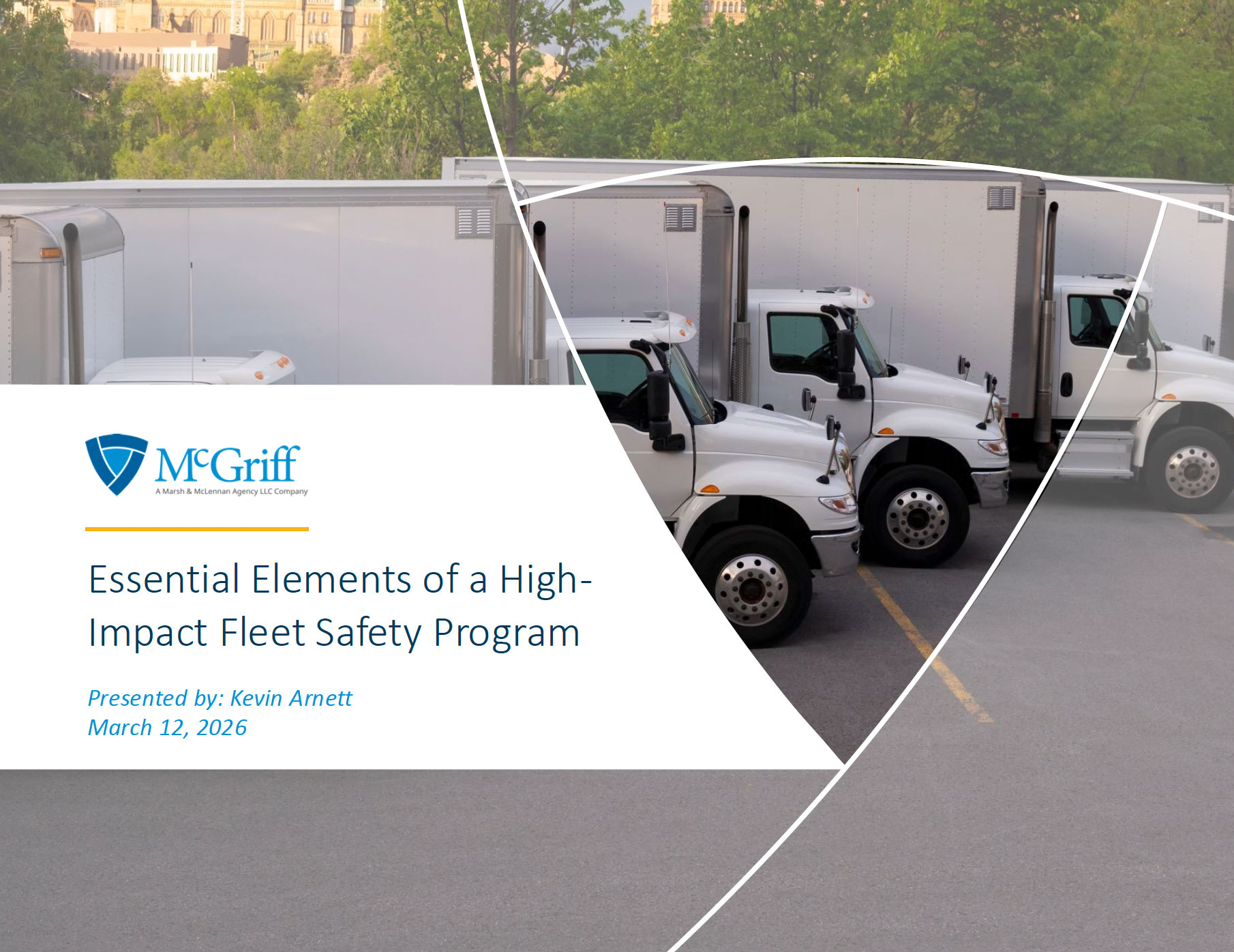
A strong fleet safety program is a powerful strategy for driving profit and operational excellence. It can boost your bottom line by reducing accidents, cutting operational costs (insurance, repairs, liability), and enhancing driver retention and productivity. Fleet safety also protects your employees, the public, and your company’s reputation.
Essential Elements of a High-Impact Fleet Safety Program


Hello everyone.
A strong fleet safety program is a powerful strategy for driving profit and operational excellence.
It directly impacts your bottom line by reducing accidents, cutting operational costs, and enhancing driver retention and productivity.
On behalf of McGriff, I would like to take this opportunity to thank each of you for joining us today as we discussed the essential elements of a high impact fleet safety program.
My name is Lesonya Wilder and I will be your host for the call today.
There are just a couple of housekeeping points that I would like to share with you before we get started.
This is a live session and you are in listen mode only.
If you have any questions at any time during this presentation, feel free to utilize the chat box or the Q&A box to type in your questions and we will address them during the Q&A segment.
If time doesn’t permit for some reason for us not to get to the Q&A section after the presentation, we will be sure to capture those questions and provide the responses afterwards.
Now it brings me great pleasure to introduce to you our speaker for the hour.
We have Kevin Arnett, a risk control consultant with McGriff, who works closely with clients to evaluate risk exposure and develop strategies, processes and safety programs to reduce their total cost of risk.
With more than 25 years of experience in the safety industry, Kevin has broad experience across several industries, including agriculture, property management, construction, skilled nursing, chemical and steel.
His experience includes working with insurance carriers to establish client safety and risk control programs.
So without further ado, I would turn it over to Kevin to kick off the presentation.
Thank you so much, Lasagna.
And I just want to say thank you for all who are able to participate in today’s webinar.
As Lasagna mentioned, I’ve been doing some form of safety now for about 2526 years, something like that.
Half of that time I was a a safety manager and more of a plant type setting.
And then the other half I’ve been some form of a consultant or in the insurance industry.
One of the things that I think is exciting about talking about fleet safety programs and why I think it’s so important is I think back to my career when it first started and how as a safety manager, I was responsible for creating programs, conducting training, things of that nature.
And what was always unique about being in a plant and, and creating safety programs that if I wanted to go out and verify how well those programs are working, it was easy for me just to walk out in the facility, kind of take a walk around, see how things were doing, making sure our employees were abiding by our safety rules and then looking for opportunities for improvement.
When you start thinking about fleet safety and our drivers are being out on the road, we don’t always get that opportunity to physically just go out and observe anytime we want, which means it’s that much more important to have the right elements in place to ensure at the end of the day, all of our employees go home just as they came in.
So for today’s agenda, we’re going to talk about a few things.
We’re going to kind of talk a little more in a little more detail about why we should prior prioritize a fleet safety program.
We’ll talk about the different elements that are essential to having a strong best in class program.
And then if we get time toward the end, we’ll spend some time going through any questions that that you’ve submitted through the chat box.
So feel free to any time to to submit your questions. Sonya Will.
We’ll jot those down, and if we don’t get to them today, we’ll be sure to follow up with you in an e-mail.
So why prioritize a fleet safety program?
Well, I think #1 we can all relate to this, that all incidents and accidents cost organizations money.
That at the end of the day, if we don’t have the right program in place, it, it can cost.
When we think about insurance in general, I’m a firm believer in this, that it’s something that you’re going to pay every year.
And every year when you pay those premiums, you’re already in the hole for that amount of money, which means a, a portion of the work we do, whether it be a delivery service, building a building, whatever the case might be, we have to do a certain amount of work just to break even.
And one of the things that can can hurt us as an organization is if we have claims, if we have incidents that occur and we have to pay those out, you can have a direct impact on on premiums.
So having a strong program at the end of the day is going to save the organization a ton of money and make you that much more profitable.
But it’s not just that when we think about all the different things and reasons why this this fleet safety program is important, I think we can hit on a few things here.
Number one, there’s the human element when we start talking about people and if someone gets hurt on the job, it impacts an organization.
Unfortunately, in my career, I’ve had an opportunity to be in a couple of situations where people died on the job.
And it’s amazing how not only does it affect management, the employees that that work with that individual, but also so the, the families that at home who depend on that individual.
But there’s also a cost when we start talking about the human element.
I’ve had a lot of organizations tell me that every time they go out and, and buy or or hire a new employee to come in and, and perform a certain work duty that there’s costs associated with that.
That by the time you do the background screens, the drug testing, in some situations you may be performing physicals, you’ve got to do onboarding.
We have to put that employee with another individual to do some on the job training.
And now we’re paying two individuals to do what 1 norm individual normally do.
We’re talking about thousands of dollars that can be spent in just getting somebody up to speed.
So there’s the human element that that’s a part of all this. There’s the reputation of the company.
If an accident happens on the job or out on the roads and your company has that company or your vehicle has that company logo on it, it’s not going to be surprising if if all of a sudden in the papers are on the news that there’s some publicity associated with that accident.
And chances are it could be bad publicity.
So by not having the right controls in place and having multiple events occur within your organization as a result relates to drivers on the road, they can have a negative impact on the company reputation.
Also, when you start thinking about vehicle repair cost, there are all kinds of reason why it cost a lot more to repair a vehicle today than it did years to go.
I think about the vehicles that I drove when I first got my license quite a few years ago and, and how those vehicles were made like a tank.
And if you hit something, chances are you might have a small Ding and a bumper and that’s it.
So there was a small cost associated with making that vehicle repair.
But in that in today’s age and time, vehicles aren’t built like they used to be, which means you’ve got more structural repairs that may have to take place.
Replacement parts can be very expensive, especially when you start thinking about the all the different sensors and cameras and the technology that’s built in the vehicles that we drive today.
That increases the cost of of repairing a vehicle.
Labor costs can be very intensive because of all these extra things we have to repair in place.
Paint finishes are not what they once were.
We have some very fancy paint finishes that if we want to put them back the way they were when we bought the vehicle from the manufacturer, there’s some costs associated with that.
And then of course, parts availability can be a challenge, especially if we want to put parts back on it.
They were the original parts put on it.
So as a result, just to repair a vehicle can add to the cost of of an accident today versus years ago.
Medical cost.
Unfortunately, in the event of an auto accident, there could be some medical bills or medical attention that has to be provided to do those involved in the accident.
When you look at some statistics, US Bureau of Labor Statistics tells us that from 2015 to 2024, medical care items rose by 26.2%, hospital services increased by 43 point O percent and physician services rose by 14.2%.
So once again, if if we compare you know, 10 years ago to today, just the medical care alone has seen an increase in overall cost.
Unfortunately also there are times when when an accident occurs, there are lawsuits that that come to the forefront.
And we would love to live in a world where if an accident occurs, we have to pay for the medical bills affiliate, affiliate with that accident that we have to pay for the repair cost of the vehicle, any, any costs associated with property damage.
But unfortunately, when lawyers get involved, that increases the cost of the claim.
There’s there’s the extra expense of having some, having someone protect you from a legal lawsuit so you’ve got your own representation.
They may go after additional dollars to pay for things like pain and suffering.
But then also in certain situations where Lauria can prove that there’s been willful neglect on your part as a company, you could have some extremely large verdicts that unfortunately exceed whatever your premiums are.
And now there’s other dollars that have to come from somewhere within your organization.
You know, statistics show that there’s been 1000% increased in in nuclear verdicts, which means we’re looking at at cases over $10 million from the time frame of 2010 to 2018.
That the average verdict when you start talking about these nuclear verdicts where we can prove there was, you know, a willful neglect that the range was anywhere from 2.3 to $22.3 million.
So the reality is, is that you’ve got lawyers that will sit in front of juries and they will convince those juries that because of the painting suffering, because of the undue stress, because of the willful neglect that the settlement should be larger for those involved.
As a result, that has an impact on on insurance premiums when it’s all said and done.
Claim settlements, When you start thinking about the settlements of these claims, even in situations where the the accidents were minor or where they were not the companies at fault.
Sometimes then in a company who has a trend of those types of cases can see an increase in their premiums of 20 to 40% and that 20 to 40% can last many years.
When you start talking about at fault accidents of your drivers, you’re definitely going to see some rate hikes.
If in the situation you don’t get dropped by your carrier and you have to look for a new partner.
There are fraudulent claims out there and, and regulatory changes that can also drive up cost and premiums.
And then of course, in these auto accidents, you could have a, a, a medical situation pop up that results in a worker’s compensation claim, which could in turn impact your company’s experience mod, which then also once again causes an increase in your premiums.
So as you can see, lots of things here that can have an impact on that overall cost.
As we spoke at at the beginning, you know you’re already starting in the hole, but as we have claims that can have a a negative impact on your premiums.
And as a result, when the new year rolls around, now we got to build that many more parts, sell that many more materials.
We got to deliver that many more pieces of equipment just to break even. So once again, just kind of recapping some of the cost.
There’s lots of direct costs.
Those are the dollars we see where we lose revenue.
There’s injury costs, there’s increase in our premiums, there’s towing costs and storage of the the damaged vehicle.
But then there’s lots of indirect costs.
With an accident, it’s the, the potential for loss of clients, prospects and sales.
Maybe we miss a meeting or two or we, we miss a drop off or a pickup. There’s lost work time for your employees.
There’s those cost to rehire and train replacement employees in the event accidents bad enough the employee can’t return to work.
We could have loss of personal property replacement vehicle rentals and that could even cost additional downtime.
Because chances are if you’re a service company who has has a vehicle set up, maybe it’s like a van that that has all the employees, equipment and tools and everything just lined up right where they can hit the field and knockout work as work arises.
There are times where we don’t have the same set up in those replacement vehicles and it does cause a delay in our ability to get work done.
Fines and penalties increase public relation costs because of poor image.
These are all costs associated with with injuries and accidents related to vehicular events.
Now there’s some good news.
If you look at the statistics, you’ll see that that the fatality and incident rates in January of 2025 through June of 2025 did show a decrease compared to the previous years.
There’s probably a lot of reasons for that.
Maybe it’s the new technology on the vehicles, maybe it’s the continued driver education, lots of lots of reasons why that could be happening.
What is scary though is when you break down that information, you’ll still see that 90% of all the traffic accidents are related to human error.
Key factors that that they’re causing those events are the speeding, impaired driving.
Still lots of distractions inside that vehicle.
There are leading to to a lot of deaths on the road.
It’s failure to wear the proper safety equipment, it’s failure to use the safety equipment that’s associated with the vehicle.
So while the numbers are coming down, which we would all be excited about, I think the downside is we, we still know there’s room for improvement because we still have drivers on the road making bad decisions.
So with that being said, those are some of the whys of, of why this is all important.
Now let’s kind of talk about some of the things we as an organization do to set ourselves up for success.
The the things that are that we would consider best in class programs, policies, procedures to to set yourself up for success.
Throughout the bat, we’ll start talking.
We’ll start by talking about the strategic hiring and MVR checks.
It all starts with understanding the background of our drivers, right?
Knowing who we’re going to put behind the wheel of our vehicles and and sorry about that.
And as part of that program, we should be running motor vehicle records on all of our drivers.
It should be something that we do when we first hire the driver, and it should be something that we continue to do once you’re thereafter to try to figure out what’s going on with that individual driving habits when they’re not at work.
Because ultimately those bad driving behaviors when they’re not at work can translate to bad driving behaviors while they’re in that company vehicle.
So we establish a strong MVR program. This is what it does.
It helps us flag risky driving behavior for anyone that we’re putting behind the wheel of our vehicle, which in turn protects our vehicles.
It helps us avoid accidents.
It helps us to prevent insurance claims, which then in turn helps keep those premiums as low as possible.
And then it also minimizes our business disruptions.
Some of you may say, well, I’m not sure what an MVR is, Kevin, what what is an MVR?
Well, it’s a history of someone’s driving record that looks at things like their overall moving violations, chargeable accidents, DUI fences, suspensions or revocations, point accumulations, any restrictions that may have associated with their driver’s license, any vehicular crimes.
The key is, as a company, what we should be doing is we should be going back and looking at the history to determine, you know what, what is this potential?
What’s the potential for this employee to be behind the wheel of one of our vehicles and have some of those same type of bad habits or same type of events take place Now I get the question all the time from my clients.
Well, how far should we go back and, and look at a driver’s history?
And, and the first thing I’ll say is this is that you, that, that it depends on the state you’re in there.
There’s no one answer that, that covers everyone, which means the best thing you can do is work with your, your contacts at McGriff with your insurance underwriters to find out what the state rules are for the state you’re in.
And they can tell you how far back we can go.
You know, in some states it’s three years, some states it’s five years, some states it’s 10.
It can also have an impact whether or not we’re talking about DLT versus non the DLT fleets.
So just work with your McGriff contact and they can advise you on what makes sense for you and your organization based on the states you operate in.
Now as part of that in VR process, it isn’t just enough just to look at the history of the data and say, yeah, we’re going to let Kevin R net driver.
No, we’re not.
It probably makes all the sense in the world to have defined grading criteria that we use to evaluate Kevin against to ensure we’re consistent across the organization.
And I think anyone in a in a human resources role would tell you consistency is key with anything we do.
When you start talking about accountability in the workplace, disciplinary actions, things like that, we want to hold everyone to the same standard.
So it’s very important that as we begin to run these MVRS that we establish A criteria that we used to say, yes, we are going to allow Kevin Arnett to operate one of our vehicles or we’re going to put him on probation or he is going to be 100% prohibited.
There’s no one, one type of evaluation process that’s acceptable.
On this screen, you’ll see that I put together an example of a chart that kind of talks about moving violations versus number of incidents within the past five years, also talking about things such as Duis across that same time.
Something like this is a great tool to use to ensure that that we’re holding all of our employees to the same standard.
I can also tell you all the insurance carriers, when they’re doing some form of an evaluation of drivers are going to be on a policy.
They have grading criteria they’re using.
That way they hold all the same drivers that they’re evaluating to the same standard.
So it’s definitely in the best interest of the organization to to establish some type of a matrix or grading policy that can be used so that we were consistent as we evaluate each and every one of our drivers initially and annually thereafter.
Now, in addition to MVRS, it probably makes all the sense in the world to have all your policies and procedures in writing.
I, I’m a firm believer in this, that we can’t rely on common sense that that we definitely want to educate and to be consistent and to ensure that we’re holding all of our drivers to the same standard.
It, it makes all the sense in the world to have a written policy that we train the drivers to.
We have those drivers sign off on that policy and then we can put that in the driver’s record because once again, what does this policy do for us?
Well, it helps to ensure we have clear expectations and there’s going to be accountability, consistent enforcement.
It can help.
These written programs can help with legal and regulatory compliance. Your insurance carriers definitely like to see your policies in writing.
So there’s some insurance benefits.
It definitely promotes a safety culture.
And then once again, the fewer incidents we have because the drivers are doing the right things on the road, the better we’re out off we are at protecting our company reputation.
There’s all types of different policies out there that you could implement. Once again, the format doesn’t matter.
It’s all about the content.
And let’s kind of run through some of these.
And if you’re missing any of these programs I’m about to cover, feel free to reach out to once again, you’re McGriff contact and they can work with you to set you up with some templates you can use to either put something in place or improve what you have that you’ve already have established.
So first one we’re going to talk about is just a standard fleet safety program.
It’s a program that within the written documents going to talk about our recruitment process.
It’s going to talk about any drug and alcohol testing we may do.
It’s going to talk about job requirements, training expectations, the basic vehicle operation guidelines that we expect somebody to follow.
There may be some guidelines in there related to distracted driving and what is not permitted as a company.
Within that program.
There’s going to be some guidelines talking about pre trip inspections and maintenance, what we do from an Accident Investigation procedure if something were to occur, rules for personal use of that company owned vehicle in situations where we allow someone to take the vehicle home.
We’ll list out prohibited behaviors in its own section within that policy.
And then at the end you’re normally going to have your employee acknowledgement and then any checklist or forms you expect that employee to complete.
So that is an example of of one type of policy.
It probably makes sense for anyone who has a fleet of any kind to have in place.
Also, in situations where we’re going to be allowing personal use of company owned vehicles, we may want to get even more detailed with a policy then within this policy.
What makes it different than the last policy is not only is it going to cover the vehicular use, but it’s going to talk about passengers or other driver guidelines outside of the norm.
It’ll talk about what driver criteria will be established, who’s allowed to operate that vehicle once it’s taken to someone’s house, which is usually only company approved employees.
He’ll talk about how the same drug and alcohol testing procedures apply, the same Accident Investigation procedures apply, if there’s any additional preventive maintenance is required as a result.
And then of course, the employees would want to get acknowledge this one just like they would the other program.
You know, we see a lot of claims where employees are allowed to take their vehicles home and then they have accidents because they were running to the grocery, pulling a boat, to a boat ramp, whatever the case may be.
And in those situations, if we haven’t made it clear to the employees about what’s allowed and what’s not allowed, we can end up with a lot of claims that still go against your company insurance that weren’t related to a work related event.
So, so the key is, once again, anything we can put in writing, anything that we can get an employee acknowledgement on helps us out from a standpoint of accountability with our drivers.
Now, I have seen situations where companies will allow employees to use their vehicles for work purposes.
Once again, this is definitely something that’s very common, but you need to have a written program for it as well.
What I’ll say here is the one thing that makes this policy a little different than the others we’ve already take or discussed is not only are we going to once again talk about the drug and alcohol testing and the Accident Investigation procedures and and things of that nature, but we should be doing two things.
We should be verifying for sure that the employee has a valid driver’s license, that the vehicle is properly licensed, and then two, that we understand what type of insurance requirements and limits the employee is carrying on their vehicle.
What I can tell you is for most insurance carriers, they like to see something above what what is considered the basic minimum in most states.
So if an employee is only carrying 25,000 for a bodily injury per person and 50,000 for a bodily injury per accident or 25,000 for property damage per accident, there’s not a lot of coverage there.
In the event that that vehicle’s involved in a work related incident, even though it’s still the employee’s vehicle there, there’s still could be some coverage that kicks in from your carrier, your, your own person, your company policies.
You know what a lot of the carriers like to see and, and once again, this can vary by state, it can vary by carrier, which means you need to work with your McGriff contacts and they can tell you what’s required based on the policies that you have in place.
But a basic minimum, lot of carriers like to see 100,000 for bodily injury per person, 300,000 for bodily injury per accident or 100,000 for property damage per accident.
You know, those are the limits they kind of like to see.
So I think it’s very important for you to understand, you know, what does your current carrier expect?
What are your state requirements or, and what, what are the minimums in your state to understand?
Is there enough coverage there to give the, the company the most protection possible?
The last policy that we’ll cover before we move kind of on to the next topic is going to be a distracted driver policy.
Now, sometimes you’ll see these same guidelines that built into the overall policy and I’ve seen companies that break it out specific because as we talked about before, you know, 90% of the accidents out there are still caused by human error.
Some of that is could be distracted driving.
So as a result, a lot of companies will create a stand alone policy that will talk about what their cell phone policy is and and and what type of hands free devices are allowed or not allowed and if voice texts are allowed and what type of electronics can be used inside a vehicle.
What the policies are around eating or drinking. It’s no.
Once again, it’s another great policy to ensure your employees understand what your expectations are to getting behind the wheel of that company vehicle.
So let’s talk about training.
It’s not just enough to have the policies, but I think it’s definitely important to make sure we’re doing all the right training with our employees.
You definitely can’t rely on common sense because I think we all understand the the concept of common sense isn’t always that common.
Also, everyone has a different background.
There’s different equipment that they’re used to being in and out of.
So I think it’s important for for each and every company to have a strong fleet safety training program, just like you would for lockout tag out, confined space emergency action plan.
The more trained your employees are, the more well versed they are on your policies and procedures and expectations, the more success that you’re going to have as a company at eliminating auto type accidents.
So what are the advantages of a solid driver training program? Enhances driver safety.
Once again, it ensures regulatory compliance.
It helps reduce our liability and cost, especially when you start thinking about once again those nuclear verdicts where, where maybe a company is told that, that once again we can prove willful negligence.
Well, if we’ve got a strong safety program in place, it it kind of helps defend us in that realm.
It can help improve operational efficiency.
It can help us ensure that we’re prepared for those emergencies if they were to happen.
It can help promote professionalism, responsibility, and it definitely ensures that the drivers are familiar with the technology that they’re going to be exposed to in that vehicle.
Older vehicles don’t have all the same bells and wheels on them as the newer vehicles.
And as companies go out and purchase vehicles, they’re buying vehicles that have lane detection systems, fancier radios, all kinds of buttons that maybe an employee is not used to in their own personal vehicle.
So it’s, it’s our responsibility as a company to ensure they understand all of that.
So when we start talking about training and the types of training, there’s all kinds of trainings you can do in addition to reviewing your policies and having the employee sign off from the policies.
Maybe you do some classroom training where we’re, we’re covering videos, handouts or PowerPoints with the the employees.
Maybe there’s some online training.
A lot of companies have invested money in in learning management systems.
And at McGriff, we have a learning management system and it’s available to you where you can sign drivers up for various types of defensive driver training to help increase their awareness.
In addition to the, the, the classroom and, and, and, and video type trainings.
Maybe you go out and you do some observations of, of drivers operating vehicles.
Maybe it’s setting up obstacle courses, maybe it’s doing ride along, but you want to observe those employees as they operate that vehicle.
You include in your train some after an accident training.
You know, we would love to say you’re never going to have an accident in your your company.
It related to auto, but chances are if you got a big enough lead, you’re eventually going to have a Fender Bender.
And maybe it’s not even your driver’s fault.
Maybe it’s the fault of the other driver, but your employees need to understand what your expectations are as far as what to do after an accident.
And then just like with any other safety training, you know, I’m a firm believer that every year all companies ought to have a scheduled list of the things they’re going to cover on an annual basis to, with their employees to, to strengthen their program, to increase knowledge to, to, to build awareness.
You should do the same thing with fleet safety.
And once again, that training could be classroom, it could be handouts, it could be observations, it could do LMS training.
And if you don’t know what type of training to include in a fleet safety program, as you can see on this screen here, there’s tons of training that we can do.
You know, I’m a firm believer is you ought to set out a schedule at the beginning of the year.
And maybe one of the things we do come, you know, when winter first gets here is we spent some time talking about winter safety and, and how the days are going to get dark that much quicker and proper preparation of the vehicle before an employee takes off for the day.
Because all the ice and frost and things that can be on the vehicle.
You know, when spring rolls around now maybe we need to start thinking about not only driving in rain, but but also we start thinking about the roadways and how on roadways we’re going to start having a lot more construction and, and we need to talk about construction, strong zone zones and being that much more of a defensive driver.
So when summer gets here, now we can, we can run through some of the basics of, of night time driving, roadway safety, lane changing mirrors and and so on, so forth throughout.
So in other words, throughout the year, there’s plenty of things we can talk about with our employees.
And if you’ve got a very big fleet, something like this really needs to be built into your ongoing train.
And we’re ride along.
So, you know, I’ve had people say, well, Kevin, I really never thought about the ride along concept when we start talking about our employees and the vehicles they drive.
Once again, if we’re trying to do everything we can to prepare our drivers for success and to ensure that they not only understand the safety features of the vehicle, but they know how to operate the controls and they can safely pull a trailer, operate a van that’s much bigger than the car they drive on a daily basis.
They understand the concept of of blind spots and these bigger vehicles then it probably makes sense to do some ride alongs.
Where with them we walk them through the process of the pre trip inspection, how we place the vehicle in motion, ensuring they understand how to work the lights and adjust the mirrors that that they can prove they know how to back and park the vehicle.
That they understand the bigger vehicles may take a longer time to to slow or stop.
That we run through our guidelines around passing and turning and what to do in intersections and proper use of seatbelts and other safety features built into that vehicle say following distances.
Because the bigger, bigger the vehicle, the further we got to back off.
So what I have to do in a a van or a larger truck is not going to be the same as as how I would normally operate my personal car that I drive on a daily basis.
And if they understand what all the different instruments on their vehicle mean, these evaluations can be done, like I said, with ride alongs that can be obstacle courses, but I think it’s also important to evaluate these, you know, on the dot side of things.
They definitely do formal evaluations and check offs of employees as they cooperative vehicle as part of your training program.
I’m I’m a firm believer that if you want to prove to someone that you’re doing everything you can to make your employees safe, if there’s no willful neglect, the more things you can document, the better off you’re going to be.
So next, let’s talk a little bit about preventive maintenance.
You know, with these vehicles, accidents can occur because of a vehicle failure or because tires weren’t in great shape.
So it’s important for us to understand that vehicle maintenance is just as important as all the things that we just talked about, but properly maintain our vehicles that helps to ensure the safety of our passengers, operators and the public, minimizes service disruptions due to vehicle equipment failures.
It promotes cost effective operations and reduces vehicle downtime.
And then when we think about these, it also helps to ensure that we’re complying with any federal, state or local regulations that we need to comply with you when you start thinking about preventive maintenance for the different elements.
Well, there ought to be a pre trip inspection program for any type of vehicle that we operate, no matter how large or small that vehicle is.
There ought to be some inspections that are done by some type of a professional.
So you’re going to have some type of a a mechanic inspection for who can also perform all your routine service work.
The employees should be expected to properly clean and maintain the vehicles.
There ought to be guidelines in for when repairs have to be made, what the policies are going to be.
And then as a company, you should maintain documentation of what vehicle maintenance is taking place.
And we start talking about documentation.
You know, you start with the vehicle inspections.
You’re going to have a vehicle inspection checklist that may be pretty small or simplified for your, your, your daily or weekly inspections that your employees are completing for, for the vehicle that they’re going to operate.
But then you’re going to have something that’s going to be probably much more detailed related to the professionals or mechanics you’re going to be responsible for doing those inspections.
I get asked all the time, you know, how long should you maintain these records?
You know, I don’t necessarily know that you got to maintain them for the life of the vehicle.
You know, for vehicle inspections for the daily ones that your employees are are completing, you know, probably a good rule of thumb is maybe six months worth of data just to show your due diligence in the event something were to happen to you were at produce documentation for your mechanics.
They’re probably going to keep a couple of years worth of records on file.
And then you also, of course, would want to check from, from from a DLT standpoint, what the DLT guidelines are because there may be some things there that the, that FM, CSA and the DLT expect you to maintain for a specific amount of time.
He is of those.
Once again, those guidelines should be built in to your company policy.
That way your management understand what needs to be maintained to meet your your criteria.
Now we talked about the very beginning of this presentation.
How you know, one of the hard parts about fleet safety is you can’t just go out at any time and observe employees operating these vehicles.
There are times when they’re counties away, states away, and it’s just not possible for you to to observe what they’re doing.
That’s when companies have an opportunity to start looking at things like technology and data analytics to strengthen their program.
What are the benefits of using this type of technology? Well, use your real time monitoring.
So while I can’t be out there physically observing the employee as they operate the vehicle, I can at least go in and look at some data on a computer that tells me what speeds are my drivers operating at.
What type of heartbreaking has happened?
It helps give you accurate incident recording where if an event were to take place, you can go back and look at some data to tell you some things that maybe the employee did not reveal during the Accident Investigation process.
It allows you to do some driver coaching and feedback.
You know, one of the things that we want to do as a company is realize that that not all employees intentionally break the rules.
There are times they just don’t realize what they’ve done and, and maybe even why they’ve done it.
So it allows us to look for opportunities, trends, and then use that to coach people.
I’m also a firm believer that if if we fired somebody every single time they made a mistake, that that if you went out and hired somebody new, there’s a cost associated with that.
But there’s also no guarantee that the person we’re hiring is any better than the one we let go.
So we want to try to coach people up as much as possible using this technology.
It helps improve compliance it it helps enhance communication between the organization and their drivers.
It helps reduce operational cost.
It can help bolster your fleet security if a vehicle gets stolen.
Sometimes the technology on these vehicles can help you you locate a vehicle and then overall can help reduce some of the administrative costs of keeping up with when does a vehicle need to be serviced?
When’s when does it need to be taken out of out of our fleet because of a certain number of mileage.
It, it can help track all that kind of information.
You know, some of the other things that that I’m a big firm believer in is, you know, it helps identify risk patterns, which means that we can take something we’re a lot of times we’re reacting to accidents.
If we’ve got the data in front of us, we can be a little more proactive and we can, we can determine what we, we expect from our drivers.
Look for those drivers who are doing all the right things and pat them on the back and thank you for a job well done.
But then also look for those drivers who who maybe are are toward the bottom of the list of, of at at risk drivers or, or or potentially having the most offenses and using that as an opportunity to coach people up.
The key is if that I can tell you a lot about what, what could potentially be happening in the future with our our drivers that we’re putting behind our company vehicles.
So when you think about the different technology, you know, once again, there could be GPS systems out there to help us track vehicle speed, the hard breaking acceleration if the vehicle is just sitting, idling a lot, which is a waste of gas.
There are dash cams and they have video technology out there that can help us detect if someone’s distracted while they’re driving, if they’re wearing their seatbelts, if they’re doing anything that could potentially be an unsafe maneuver that could cause an accident.
There’s electronic log, the electronic logging devices that help us monitor hours on the road and, and, and help us comply with various regulations, especially when you start talking about dot and the FMCSA, those, a lot of these systems come with predictive analytic platforms that help you identify your, your best drivers and your at risk drivers.
And then once again, within these systems, there’s all kinds of maintenance software that can be built into them to help you schedule and track vehicle maintenance, which helps to minimize breakdowns and unsafe conditions.
Now I will say this, if you’re going to use this type of technology, it probably makes sense to once again have a fleet telematics policy for a couple reasons.
Number one, it’s I think it’s important for us to educate our employees on what their roles and responsibilities are and and what the policy guidelines are for the GPS and dash cams.
What disciplinary actions could could happen as a result of findings and observations from the technology, how the company plans to use it and then have the employee sign off.
But in addition to that, different states have different rules for how we have to notify the employees of these systems and, and how the data will be used.
So once again, because all the rules are different from state to state, I’m just going to encourage you to work with your, your state insurance department, your legal counsel, any regulatory resources that are out there, work with your McGriff contact to find out what are the laws for my state?
What do I need to know?
What kind of of notices do I need to give to my employees? Because we’re going to be using dash cams and GPS.
And then make sure you get the documentation to go along with it so that way you can prove you’ve properly educated your staff.
Now in the event there were to be an accident, I think it’s important for your employees to understand that there are some things that we kind of expect from those employees.
So once again, we’re going to have written policy for this and within the Accident Investigation program we’re going to have, we’re going to have sections that help us identify root causes that that’s the primary role responsibility of doing Accident Investigation after an auto accident.
It helps prevent future accidents.
It helps us to ensure consistency and fairness.
It helps us facilitate accurate reporting, helps us to comply with insurance regulations, and then, of course, by having a written policy that everyone signed off on, it gives us an opportunity to take what incidents and accidents we have had and use that data to drive improvements within the organization.
You know, when you educate your staff, I think it’s important to to educate the staff on who’s responsible for initiating, initiating and conducting the investigation.
For some companies have a fleet manager, for some, there’s a safety officer.
For some, it could be the driver themselves.
But I think that it’s important to outline who, what everyone’s role and responsibility are are and then what will happen once the event takes place.
You know what, what are the supervisors, HR, legal and insurance representatives going to do as a result of this accident?
We should talk about your reporting procedures. Who do we call?
When do we call?
What forms do we complete during the investigation process?
We should make sure our employees understand that we need to to not only never admit fault when an accident occurs, but that they understand that we may need their help gathering evidence.
So if an event takes place, we need them taking photos, doing them vehicle inspections of not only their vehicle, but the other vehicle, getting names of witnesses, you know, helping to establish timelines.
You know, because there’s once again, a lot of these accidents can occur in situations where management physically can’t go to the site to, to do the Accident Investigation that we’re relying on the employees to gather a lot of this information for us.
So it’s important not only to educate them on what we need them to gather, but then provide them the forms that they can properly help document and report this to management.
You know, once again, I think it’s important to make sure our employees understand that there are forms we need to complete.
There are post accident procedures that we need them to follow.
And then at any time during the accident, accident itself, when they’re at the scene, never to admit fault, make sure everyone’s safe, gather the right information, exchange insurance information, exchange driver info.
And then if possible, make sure that that we get any type of a report numbers from the police officers who may be on scene so we can get a police report at A at a later date.
I’ve seen companies who, because it seems like a such a complex process, they’ll create checklist for their employees that the employee can use to, to ensure they don’t forget to do something in the event there were to be an accident.
So you can see on this checklist that we’ll talk about once again, you know, making sure that we get pictures, that we get witness statements, that we get stuff related to the police report that that we’re, we’re getting.
We document damage that, that as a company, that we’re making sure we do all the right drug and alcohol testing.
That if there’s any post acts and actions that we need to follow up on that we can follow up on.
These are just great tools to ensure everybody’s on the on the same page when it comes to not forgetting something as a result of an accident.
It also probably makes a lot of sense in addition to a checklist, but to provide the employee with some type of an accident record that they can fill out.
Once again, this helps to ensure that they’re gathering all the key information.
So yes, we, we know we got to walk around and take pictures, but now we’re going to make sure that we’re right down in the day and time and the location, what may be the weather conditions were in the condition of the road, the, the information related to our vehicle, but then information related to the other vehicle, names of the other passengers and pedestrians.
And then it’s always a good idea because sometimes these things can be investigated way down the road to, to have things in addition to the pictures that can help kind of jolt an employee’s memory of what happened the day of an accident.
So as you can see in this Accident Investigation form that would be kept in a vehicle, we have the ability to kind of jot down the, the OR diagram the accident scene.
We can show at the intersection who was where and, and how or maybe where someone was pulling out or if it was in a parking lot, how the position the vehicles were positioned in the parking lot.
It just helps to ensure that not only we’re getting all the correct information now because we wanted, we want to teach our employees how important is to report accidents as soon as they occur.
But then if we need to kind of go back and, and get further statements or, or talk about these things two weeks from now, three weeks from now, six months from now that we have documents like this that can refresh someone’s memory on what happened the day the incident occurred.
So just to kind of wrap up, you know, there’s lots of reasons for having a strong fleet safety program.
And I hope some of the things you took away from this were, number one, we have to do this to protect the employees, right?
You know, some of the worst things I’ve ever experienced in my career.
We’re dealing with major accidents, even fatalities where someone’s life was taken and it’s not fun.
So so there’s that piece of it where we want to ensure our employees go home just like they came to work.
Also, when we go to replace those employees with someone else, there’s all kinds of costs associated with just hiring somewhere new.
So we do it to protect our employees, you know, by by having a strong fleet safety program can lower those financial costs, especially when you start talking about insurance premiums.
If we, if we have accidents, even even accidents are not the fault of the company because you could have an uninsured motorist who comes into contact one of our vehicles.
Those can have impacts on premiums.
So we want to make sure that that we do everything we can to, to minimize that cost because premiums as you know are not a one time cost.
It’s something we’re going to pay every year.
So the the more we can reduce those costs, the better off we are going to be financially.
As a company, it helps to ensure regulatory compliance.
By doing all this stuff, we never have to worry about whether or not we’re compliance with local or state regulations or for following a proper dot and FMCSA guidelines and expectations.
We know we’re going to be in compliance.
Now we don’t have to worry about any types of fines associated with not doing the right things.
It can help us improve operational efficiency.
Efficiency now there’s not downtime associated with the accident.
Now we’re spending all of our time servicing customers, making deliveries, doing the things that makes us profitable as a company versus sitting on the side of the road trying to figure out what happened, how it happened, why it happened, or worrying about when an employee may or may not be able to come back to work.
It’s going to protect our company reputation.
Once again.
Most company vehicles have that company logo on the side, and as that vehicles gets involved in an accident, it’s going to be that logo.
Doesn’t matter whose fault it was that makes the news that makes the local paper.
And bad publicity is always a bad thing. I haven’t a strong fleet safety program.
Again, it helps mitigate our risk exposure.
You know, going back and talking about when, when lawyers get involved in, in these auto accidents, they’re looking for any opportunity at all to show negligence on the part of the company.
Because if there is negligence, then that’s an opportunity to receive higher settlement dollars, which means more money not only for the the injured party or the party who’s who’s suing, but also it’s more money for the lawyers and just to fight those.
Even if you’re in the right just to fight, those are the cost to that of having your own legal counsel protect you in the court of law.
So by doing all the right things, that helps minimize that exposure.
By having all these tools in place, that helps promote that accountability with our drivers.
I’m a firm believer that without accountability, there’s not always going to be responsibility.
So you have to set expectations and then hold your employees to those expectations.
So that way we can be consistent.
And then as a company, my guess is you all have goals.
You, you, you have goals related to safety, you have goals related to profitability, You may have goals related to keeping those insurance premiums down.
Well, by having all these strong programs and policies in place, it ensures that we’re doing everything we can to to be as profitable and successful as we can as a company at the end of the day.
So with that being said, thank you for everyone’s time on this call today.
I appreciate you, you you calling in, logging in, wherever the case might be, and participating in this meeting.
I’m not going to turn over to Lasagna.
I’m not sure how much time we got left Lasagna, but if there’s a couple of questions I can try to answer, I will.
And if I can’t answer, we will definitely do the research and get back with those individuals.
Awesome.
Thank you so much, Kevin, for that wonderful presentation. And I have gotten a couple of questions in the box.
Just to let everyone know, you will receive a copy of this presentation as well as the recording afterwards.
But in addition to that, one of the questions that came through and if anyone else has any other questions, feel free to utilize the chat box or the Q&A box at this time.
But one of the questions we did receive, Kevin, is what if the driver is A foreman and can’t be placed in a non driving position?
So what if the form?
Well, I think that’s once again now a situation where you as a company are going to work with whoever your McGriff contact is.
It’s probably going to be, you know, who’s, whoever helps you place your insurance and, and between the two of you and, and the carrier, there’s going to have to be some pretty tough discussions about this driver, whether or not they can be on the policy.
I’ve seen situations where carriers have have made allowances in situations where maybe you’ve got all the right technology in the place, you’ve done certain types of trainings and, and as a result, they, they, they will have a few exceptions, but a lot of times that that’s going to be based on discussions with that insurance carrier.
I’ve also seen times where carriers have simply refused to allow someone on the policy because of a bad motor vehicle reference check.
And then in situations like that now as an organization, you, you, you may be forced to ask the tough question.
Can this can this person physically do all their essential job functions and if driving’s one of them?
If the answer is no, we may unfortunately have to let someone go.
That would not be the the priority of course that we would want to try to do everything we could to keep the person employed and on the books, but ends up resulting in some pretty tough conversations between the company McGriff and and the insurance carrier at that point.
Awesome, thank you.
And then the other question we have, I know you during the call you did mention some resources and they want to know where can we find some of the resources shown and or mentioned.
Yeah.
So what I would, I would do is this, you know, when you start looking, a lot of those written policies that I showed McGriff provides all of our, our clients access to a thing called McGriff Resource Net.
There’s a lot of written, all the same policies and procedures that that I showed during this presentation are all available through McGriff Resource Net.
And if you don’t have access, get with whoever your risk control contact is or get with whoever your producer is at McGriff.
They can get you signed up.
They can also themselves help download some of that information and send it to you.
They can also do the same thing with training materials within that McGriff resource net.
There’s PowerPoint presentations, there’s one page handouts.
And then we we have the ability to sign you up for what we call a learning management platform, which gives you access to some of those videos.
And, and that can all be done via working with your McGriff wrist control contact or or with whoever your contact is at McGriff.
And one of the things I can say is this, if you do decide to go the route of our learning management platform, one of the people that you’ll end up working with some is Lasagna, who, who’s on this call.
So she’s easy to work with.
She’s very knowledgeable of our systems.
So if, if, if you’re looking for an avenue of doing some computer based training, we have, we have something available for you.
Absolutely.
And we’ll be happy to assist you with those resources. All right.
So thank you all again.
Thank you Kevin again for that wonderful presentation.
Like I said, everyone will receive a copy of the presentation as well as the recording.
You’ll have Kevin’s contact information.
So if any questions arise after you get out the call, you will have his contact information and you can easily shoot him an e-mail.
But again, on behalf of McGriff, thank you all for your time and we hope you all have of a wonderful rest of your day.
Download the PDF Presentation